Our role
Our role is to guide Aotearoa New Zealand to change in ways that will help address the global problem of climate change.
The Climate Change Commission is an independent Crown entity established under the Climate Change Response Act 2002.
Although we're small, the Climate Change Commission has a unique and important role in enabling climate action in Aotearoa New Zealand.
We do this by providing independent, expert advice to the Government on both mitigating and adapting to the effects of climate change. We also monitor and review the Government's progress towards its emissions reduction and adaptation goals.
We are independent from the Government – we don't write climate policy, set targets or regulations, or implement the Government's climate initiatives.
Our role is set out in law
Our purpose is set out in the Climate Change Response Act 2022 (the Act), which is to:
- provide independent, evidence-based advice to successive governments on mitigating climate change (including through reducing emissions of greenhouse gases) and adapting to the effects of climate change.
- monitor and review progress towards emissions reduction and adaptation.
Our analysis supports the Government to fulfil its roles under the Act, including achieving emissions budgets and the 2050 target, and allowing the people of Aotearoa New Zealand to prepare for, and adapt to, the effects of climate change.
Our impartial advice focuses on the outcomes that can result from government action and policy, and the choices that decision-makers have. It's then over to those decision-makers to choose how they respond.
The diagram below shows how we fit into Aotearoa New Zealand's system of climate policy and action.
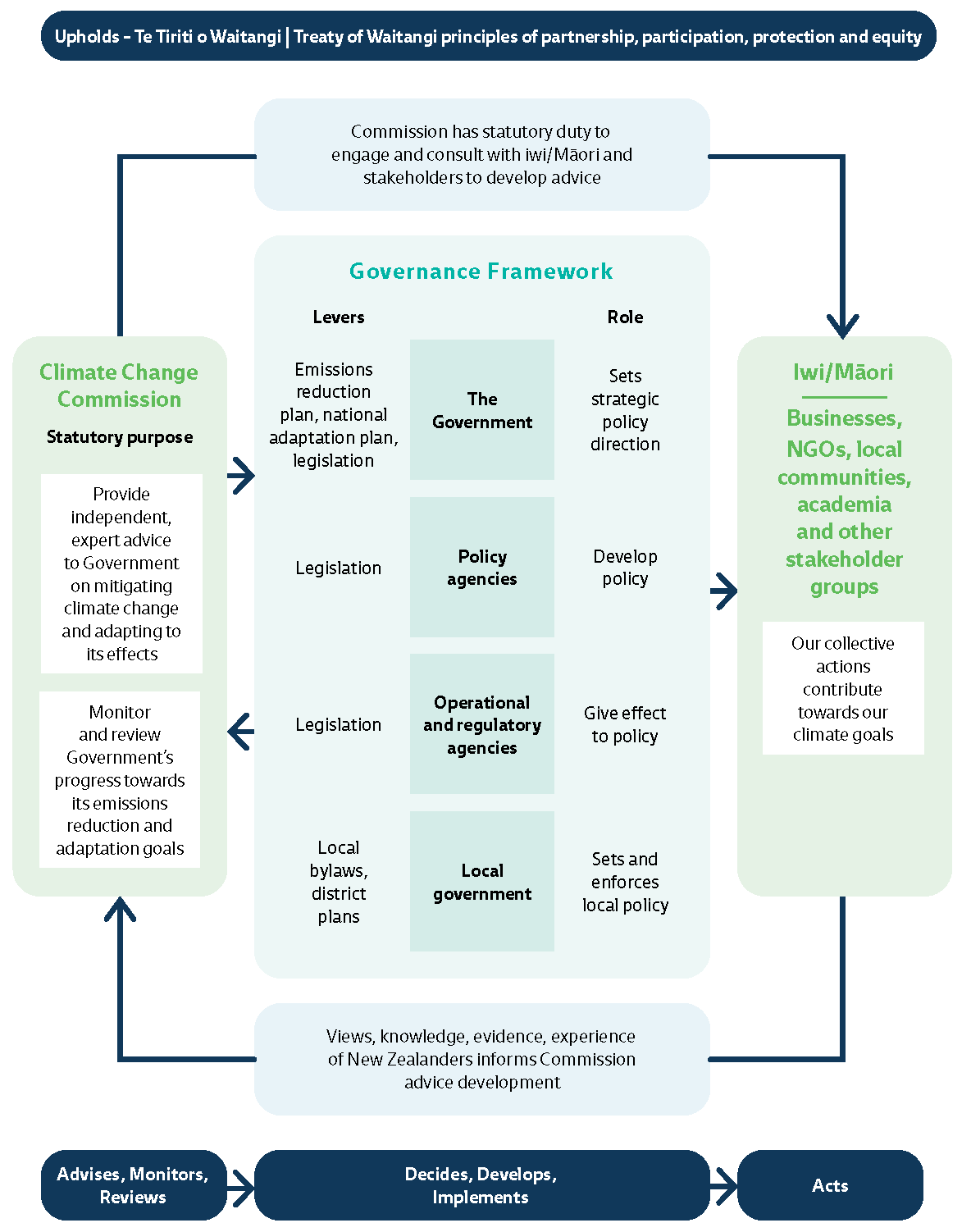
Our role in Aotearoa New Zealand's climate policy and action system.
What we do
The work programme given to us by the Act is often quite specific.
The scope and timeframes for the reports we produce are set out in the Act (and, in many cases, what a particular report needs to consider).
We produce nine different types of report on a regular basis, and other reports in special circumstances. We provide our reports to the Minister of Climate Change, who then presents them to Parliament.
Read more about how we produce our reports.
Shaping our thinking: Evidence and engagement
The Act tells us not just what work to do, but how we must approach it – whether that's specific things our reports must cover, or broader things we need to think about.
In carrying out its work, the Act requires the Commission to draw from the best available evidence and analysis, and to consider the impacts of climate change and the implications for Aotearoa New Zealand over time.
The Act also directs us to consider the Crown–Māori relationship, te ao Māori, and specific effects on iwi/Māori in our work.
Evidence can take a range of forms, including academic journal articles, mātauranga Māori, information from organisations and communities, and people’s lived experience observing and adapting to the changing climate.
As part of sharing our thinking, we publish the evidence and analysis that inform our reports – such as our case studies, submissions we receive from the public, independent reports we commission, and our modelling.
Engaging with the public
Engagement is at the heart of what we do – to ensure we have the best available evidence to draw on, to inform our work with views and experiences from across the motu, and to test our analysis against public input.
In some cases (such as when developing our advice on emissions budgets) we are required to formally consult the public. At other times, we may seek input and feedback in less formal ways.
When we are undertaking consultation, calls for evidence, or seeking other written input, you can learn more and share your feedback through our engagement website:
Have Your Say | Climate Change Commission
Other ways you can get involved include attending our events, meeting with our staff, or by getting in touch with us with any questions.